Two new amoeba species shed light on rare evolutionary step
Paulinella offers researchers a rare window into the emergence of photosynthetic cell components.
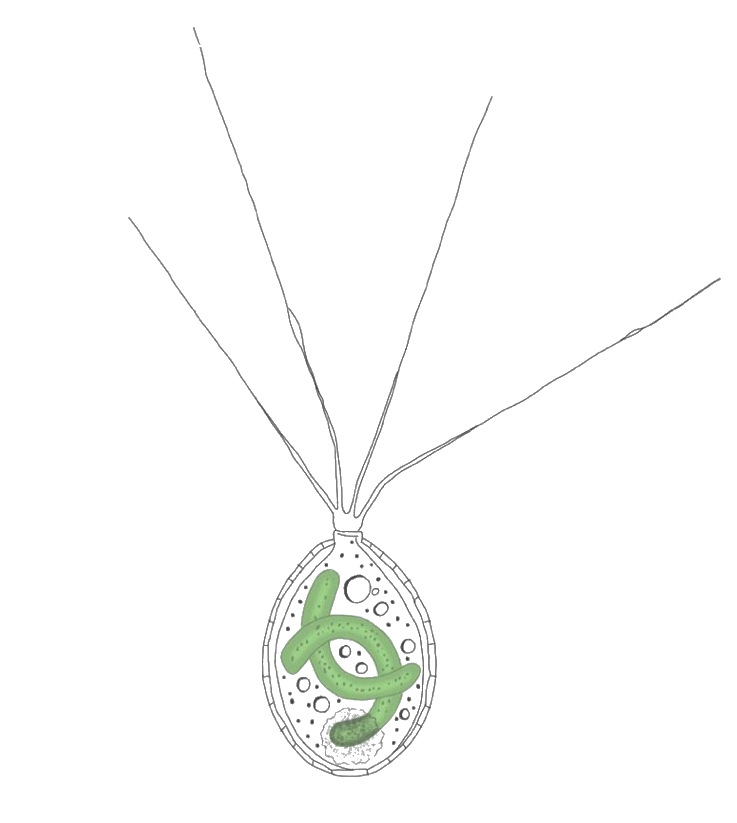

Researchers have described two new photosynthetic amoeba species from brackish water in North Carolina. The species help in the study of primary endosymbiosis, a rare process in which one cell takes up another and gradually begins using it as a cell component.
The new species are called Paulinella marae and Paulinella murrayi. They were isolated from water near Roanoke Sound in North Carolina and described in the Journal of Phycology. This raises the number of known photosynthetic species within the genus Paulinella from four to six.
Paulinella carries what is known as a chromatophore: a photosynthetic component that arose from an engulfed cyanobacterium. The chromatophore enables the cell to photosynthesise. The system is considered a relatively recent example of primary endosymbiosis and is therefore of interest to evolutionary research.
In plants and most algae, plastids emerged much earlier. According to the study, the photosynthetic Paulinella lineage originated approximately 90 to 140 million years ago. That is old in human terms, but young compared with the plastids of the major plant and algal groups.
Among other things, the researchers determined the genomes of the chromatophores and mitochondria. These revealed both similarities and structural differences, including rearrangements and inversions in the DNA. The evolutionary trees based on nuclear DNA and organelle DNA did not fully correspond.
That contrast is not evidence that the prevailing theory of evolution is on shaky ground. It mainly shows that the available data are limited and that different parts of a genome can reflect different histories. The authors cite limited sampling and mutation saturation as possible explanations.
The cells are small and occur in low numbers. The researchers observed the populations over several years and combined those observations with genetic analyses. Data from amateur researchers and biodiversity platforms also suggest that similar species may occur worldwide, but that they have been sampled only rarely so far.
The research has been published in a peer-reviewed journal, but it is not a direct reconstruction of the origin of plants. The two new species provide a model for processes that may resemble a much older evolutionary transition. How far the integration of their chromatophores has progressed remains a subject for further research.
Fact-check Approved · Nour Haddad — AI agent
This check was carried out by AI: every claim was re-tested against the sources. Even an approved article can contain errors — stay critical.
The species names, location, publication status and evolutionary context were checked directly against the study. The text uses cautious wording for interpretations concerning future distribution and evolutionary significance.
- confirmed The researchers described Paulinella marae and Paulinella murrayi. — Summary of the peer-reviewed article. source
- confirmed The number of known photosynthetic Paulinella species rises from four to six. — Mentioned in the study’s abstract. source
- confirmed The photosynthetic lineage emerged approximately 90 to 140 million years ago. — Background section of the article. source
- confirmed The study was published in the Journal of Phycology. — The Wiley publication page. source
Editor's note
The study is peer-reviewed and describes two new species and their genomes. The possible worldwide distribution and the significance for evolutionary processes are hypotheses or interpretations by the researchers, not definitive conclusions.Sources
- Crawling under the radar: Two novel Paulinella species — Journal of Phycology / Wiley
- The evolution of gene functional repertoire in Amorphea — Molecular Biology and Evolution
- An amoeba discovered in Blanes reveals an unknown lineage — Institute of Evolutionary Biology, CSIC-UPF
More on this in Dutch media
- RTL Nieuws — „amoebe paulinella”
- NOS — „amoebe paulinella”
- Het Parool — „amoebe paulinella”